

If you have been searching for an honest Phytomem One Review, you are probably trying to answer one basic question: is this brain-support supplement actually worth considering, or is it simply another product surrounded by ambitious marketing?
That is a reasonable question.
Phytomem One is marketed as a daily dietary supplement designed to support memory, focus, mental clarity, healthy brain function, and metabolic wellness. The formula brings together 10 ingredients, including saffron extract, berberine HCl, fucoxanthin, fucoidan, oleuropein, Ceylon cinnamon, corosolic acid, kudzu flower extract, Morosil red orange extract, and xylitol.
Some of these ingredients have been studied individually. That does not, however, mean the complete Phytomem One formula has been clinically proven to produce the same outcomes.
That distinction is important.
In this detailed Phytomem One Review, we will look beyond promotional language and examine the formula from a practical consumer perspective. We will cover what Phytomem One is, how it is supposed to work, its ingredients, potential benefits, possible side effects, safety considerations, pros and cons, and the evidence behind its key ingredients.
By the end, you should have a much clearer idea of what the supplement can reasonably be expected to do—and what has not yet been established.
Affiliate Disclosure: This article may contain affiliate links. If you purchase through one of these links, we may receive a commission at no additional cost to you. This does not affect our commitment to providing balanced information.
Medical Disclaimer: This article is for educational purposes only and is not medical advice. Do not use dietary supplements to diagnose, treat, cure, or prevent a disease. Talk with your physician, pharmacist, or another qualified healthcare professional before starting a new supplement, particularly if you take medication, have a medical condition, are pregnant, or are breastfeeding.
Phytomem One Review: Quick Overview
Phytomem One belongs to the growing category of dietary supplements marketed for cognitive and brain-health support.
Rather than relying on caffeine or another stimulant to create a temporary feeling of alertness, the formula combines botanical compounds associated with several areas of research, including antioxidant activity, cognitive health, and glucose metabolism.
According to current product information, the formula contains 10 main ingredients and is marketed as stimulant-free.
The most important thing to understand at the beginning of this review is that there are two different levels of evidence to consider.
The first is ingredient-level evidence.
Researchers can study saffron, berberine, cinnamon, or another ingredient in a clinical trial and learn something about that particular substance at a particular dose.
The second is product-level evidence.
To demonstrate that Phytomem One itself produces a specific clinical outcome, researchers would ideally need to test the complete finished formula in controlled human trials.
Those are not interchangeable.
An independent review of publicly available product information similarly notes that research exists for some individual ingredients, but published clinical evidence on the finished Phytomem One formula has not been identified.
What Is Phytomem One?
Phytomem One is a dietary supplement promoted for adults who want additional nutritional support for memory, concentration, mental clarity, and healthy cognitive aging.
The product uses a multi-ingredient strategy rather than building the entire formula around a single popular nootropic.
Its ingredients can broadly be placed into three overlapping groups.
The first includes ingredients associated with antioxidant and cognitive research, such as saffron and olive-derived oleuropein.
The second includes seaweed-derived compounds such as fucoxanthin and fucoidan.
The third includes compounds more commonly discussed in metabolic-health research, such as berberine, Ceylon cinnamon, and corosolic acid.
The manufacturer connects these different pathways to brain wellness.
That concept is biologically interesting because the brain does not function in isolation. Sleep, cardiovascular health, metabolic health, physical activity, diet, stress, medications, and numerous other factors can affect how mentally sharp a person feels.
However, a plausible biological theory is not the same thing as clinical proof that a supplement improves memory.
Consumers should keep that distinction in mind throughout this Phytomem One Review.
How Is Phytomem One Supposed to Work?
The marketing behind Phytomem One focuses on providing broad support rather than simply delivering a short-lived stimulant effect.
In practical terms, the formula appears to be designed around three general concepts:
Antioxidant support: Several botanical ingredients contain naturally occurring compounds studied for antioxidant properties.
Metabolic support: Ingredients such as berberine and cinnamon have been researched for their effects on glucose metabolism.
Cognitive support: Saffron, in particular, has attracted scientific interest for possible effects related to cognition and mood.
The manufacturer then connects these pathways to everyday memory, focus, and mental clarity.
This is where responsible interpretation becomes especially important.
For example, there is legitimate scientific research on berberine and glucose metabolism. The National Center for Complementary and Integrative Health notes that research suggests berberine may affect blood glucose and insulin resistance, although the evidence has limitations.
That tells us something about berberine.
It does not automatically prove that Phytomem One improves memory because it contains berberine.
The same principle applies to every other ingredient in the formula.
Phytomem One Ingredients
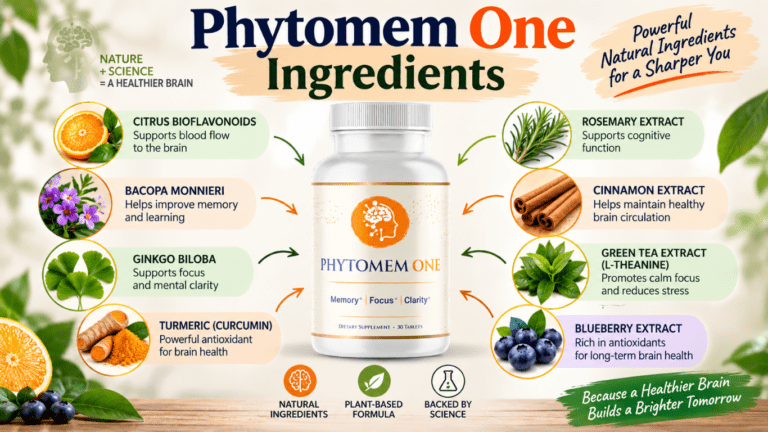
One of the strongest ways to evaluate any dietary supplement is to stop focusing on the front-label promises and examine what is actually inside.
Current product information lists these 10 Phytomem One ingredients:
- Saffron Extract
- Fucoxanthin
- Fucoidan
- Oleuropein
- Berberine HCl
- Ceylon Cinnamon Bark
- Corosolic Acid from Banaba Leaf
- Kudzu Flower Extract
- Morosil Red Orange Extract
- Xylitol
Let’s look at them individually.
1. Saffron Extract
Saffron comes from Crocus sativus and is far more than a culinary spice. Its naturally occurring compounds have been studied in areas including mood and cognitive function.
Among all the Phytomem One ingredients, saffron is one of the more interesting from a cognitive-research perspective.
A systematic review published in 2020 evaluated randomized controlled trials investigating oral saffron and cognition. Five studies involving 325 participants met the researchers’ criteria. The authors described the findings as promising but specifically cautioned that the evidence came from studies with potentially high risk of bias and that larger, better-quality trials were needed.
That gives us a good example of how supplement research should be interpreted.
It would be inaccurate to jump from those results to the statement that “Phytomem One is clinically proven to improve memory.”
The research studied saffron under particular conditions—not necessarily this exact supplement, combination, or dose.
Still, saffron gives the formula a scientifically interesting cognitive-health ingredient rather than relying solely on marketing-friendly botanicals.
2. Fucoxanthin
Fucoxanthin is a naturally occurring carotenoid found primarily in brown seaweed.
It has attracted scientific attention because of its antioxidant and metabolic properties.
Much of the excitement surrounding fucoxanthin comes from laboratory, animal, and metabolic research. Translating those findings into specific cognitive benefits for humans requires caution.
A substance can produce an interesting biological effect in cells or animals without producing a meaningful real-world cognitive improvement in people.
For that reason, fucoxanthin should be viewed as a supporting botanical compound rather than proof that the product will improve memory.
3. Fucoidan
Fucoidan is another compound obtained primarily from brown seaweed.
It is a sulfated polysaccharide and has been investigated across a range of experimental health applications.
You may encounter dramatic statements about fucoidan when reading supplement marketing online. Those statements should be interpreted according to the type and quality of research supporting them.
Research conducted in cells or animals is useful for generating scientific hypotheses, but it is not equivalent to large, well-controlled human clinical trials.
Within Phytomem One, fucoidan appears to be included primarily as part of the formula’s broader antioxidant and cellular-wellness approach.
4. Oleuropein
Oleuropein is a naturally occurring polyphenol found in olives and olive leaves.
It is one of the compounds that has helped generate scientific interest in olive-derived ingredients.
Oleuropein has antioxidant properties and has been studied in relation to cardiovascular and metabolic health, among other areas.
This makes it a reasonable complementary ingredient in a general wellness formula.
But once again, evidence supporting oleuropein as an individual compound cannot establish that the entire Phytomem One formula produces a measurable cognitive outcome.
That may sound repetitive, but it is one of the most important points in evaluating multi-ingredient supplements.
5. Berberine HCl
Berberine is probably one of the best-known ingredients in this formula.
It is a naturally occurring compound found in several plants and has a long history of traditional use.
Modern research has focused heavily on metabolic health.
NCCIH reports that a 2021 review covering 46 studies and 4,158 participants found that berberine may have beneficial effects on blood glucose, insulin resistance, and lipid metabolism in people with type 2 diabetes. At the same time, NCCIH highlights limitations in the underlying research, including variation between studies and concerns about study quality.
This is relevant because Phytomem One’s marketing emphasizes metabolic wellness as one part of its approach to brain support.
But berberine is also one reason consumers should not assume that “natural” means risk-free.
NCCIH notes that berberine can cause gastrointestinal effects such as nausea, diarrhea, bloating, and constipation. It may also interact with medications.
Anyone taking prescription medication—particularly medication affecting blood glucose—should discuss a berberine-containing supplement with a healthcare professional.
6. Ceylon Cinnamon Bark
Cinnamon is familiar to almost everyone, but concentrated cinnamon extracts are different from simply adding a little cinnamon to breakfast.
Ceylon cinnamon is often preferred in supplements over cassia cinnamon because the two varieties have different chemical profiles.
Cinnamon has been researched extensively in metabolic-health contexts, including glucose regulation.
That makes its inclusion alongside berberine understandable from a formulation standpoint.
However, people using blood-sugar-lowering medication should be particularly careful when combining multiple supplements or botanicals that may affect glucose metabolism.
Do not adjust prescription medication based on a supplement or an online review.
7. Corosolic Acid From Banaba Leaf
Corosolic acid is a compound associated with Lagerstroemia speciosa, commonly called banaba.
It has received attention mainly because of research related to glucose metabolism.
In Phytomem One, it appears to complement berberine and cinnamon as part of the metabolic side of the formula.
Again, this is a reason to pay attention to possible interactions.
Combining several ingredients with potential metabolic effects may be intentional from a formulation perspective, but it also makes professional guidance more important for people who already use diabetes medications or have problems regulating blood sugar.
8. Kudzu Flower Extract
Kudzu is a plant with a history of traditional use in East Asian herbal practices.
Different parts of the plant contain various phytochemicals, including isoflavones.
Kudzu flower extract is included as another botanical component in Phytomem One.
Compared with ingredients such as saffron and berberine, however, the direct evidence connecting kudzu flower supplementation to meaningful memory improvement is less established.
It is therefore more appropriate to describe kudzu as a supporting botanical rather than a proven memory enhancer.
9. Morosil Red Orange Extract
Morosil is a branded extract derived from Moro blood oranges from Sicily.
It contains naturally occurring compounds including anthocyanins and other polyphenols.
Morosil is more commonly associated with metabolic and body-composition research than with direct cognitive enhancement.
Its presence reinforces the idea that Phytomem One is not formulated as a conventional “brain booster” consisting only of classic nootropic ingredients.
Instead, the product combines cognitive, antioxidant, and metabolic ingredients.
Whether that combination produces a meaningful synergistic effect in humans would ultimately require research on the finished formula.
10. Xylitol
Xylitol is a sugar alcohol that is widely used as a sweetener and is particularly familiar from sugar-free gum and oral-care products.
Its role in a brain supplement is less obvious than saffron or berberine.
Consumers should therefore avoid assuming that every ingredient has strong direct evidence for improving memory simply because it appears in a cognitive-support product.
The overall formula needs to be evaluated as a whole.
Interested in the complete formula? Check the official website for the latest ingredient and product information.
Check Phytomem One Details
Does Phytomem One Work?
Now we come to the most important question in this Phytomem One Review:
Does Phytomem One actually work?
The most accurate answer is:
There is scientific interest behind some of its individual ingredients, but that is not enough to guarantee that the finished supplement will noticeably improve memory or cognitive performance.
That answer may not be as exciting as a dramatic yes or no, but it is much more useful.
There are three questions to separate.
Question 1: Do Any Phytomem One Ingredients Have Research Behind Them?
Yes.
Saffron has human research related to cognition, although systematic reviewers have emphasized limitations in the evidence.
Berberine has substantial research related to metabolic health, although this is not the same as direct proof of memory improvement.
Several other ingredients have antioxidant, metabolic, or preliminary experimental research behind them.
So it would be unfair to say that the formula contains nothing scientifically interesting.
Question 2: Has the Complete Phytomem One Formula Been Proven to Work?
This is much less clear.
At the time of this review, we did not identify published, peer-reviewed randomized controlled trials demonstrating that the finished Phytomem One formulation itself improves memory, attention, or cognitive performance.
Independent reviews examining the publicly available formula have raised the same limitation.
This matters because combinations can behave differently from isolated ingredients.
Dosage matters.
Standardization matters.
Duration matters.
The population being studied matters.
Even when an ingredient has convincing research, a product must contain an appropriate form and amount before we can reasonably expect the research to apply.
Question 3: Could Someone Still Feel a Difference?
Possibly.
People’s experiences with supplements vary considerably.
A person’s diet, age, sleep quality, exercise habits, stress level, health status, medication use, nutritional deficiencies, and expectations can all influence how they feel.
But individual experiences and testimonials cannot establish that a product works for everyone.
For SEO articles and consumer reviews, this distinction is important. Testimonials can describe experiences; they should not be presented as clinical proof.
Potential Phytomem One Benefits
Based on the formula and the manufacturer’s positioning, potential areas of support include the following.
1. Memory Support
Memory is the central reason many consumers will discover Phytomem One.
Saffron gives this part of the formula some scientific plausibility because it has been studied in randomized trials related to cognition. Still, more rigorous research is needed, and existing saffron studies should not be interpreted as direct trials of Phytomem One.
Therefore, “supports memory” is a much more responsible description than promising to restore lost memory.
2. Mental Clarity
People often describe mental clarity in terms of feeling less scattered and being able to think more comfortably through everyday tasks.
This is subjective and can be influenced by numerous factors.
Phytomem One is marketed to support mental clarity, but consumers should not interpret this as a guaranteed treatment for persistent brain fog.
Ongoing or worsening cognitive symptoms deserve medical attention because they can have many causes.
3. Focus and Concentration
Unlike many energy and focus supplements, Phytomem One is marketed as stimulant-free.
That could appeal to people who do not want another caffeine-containing product.
However, stimulant-free does not automatically mean that a supplement will noticeably increase concentration.
The expected experience may be subtler than the immediate alertness people associate with caffeine.
4. Antioxidant Support
Several ingredients in the formula—including saffron, olive-derived compounds, and seaweed-derived compounds—contain substances studied for antioxidant activity.
Oxidative stress is a normal area of biological research, including research involving aging.
But broad antioxidant properties should not be translated into claims that the supplement prevents or reverses neurological disease.
5. Metabolic Wellness
This is one of the more distinctive features of Phytomem One.
Berberine, cinnamon, corosolic acid, and other components give the formula a metabolic-health angle.
NCCIH confirms that berberine has been investigated extensively in blood-glucose research.
For healthy adults, that may make the formulation interesting.
For people already receiving treatment for diabetes or another metabolic condition, it is instead a reason to consult a healthcare professional before use.
Phytomem One Side Effects
No responsible Phytomem One Review should discuss benefits without discussing potential risks.
Natural ingredients can produce side effects.
They can also interact with prescription drugs, over-the-counter medications, and other supplements.
The FDA specifically advises consumers to speak with a doctor, pharmacist, or other healthcare professional before deciding to use a dietary supplement because supplements may interact with medicines or other supplements.
Possible Digestive Effects
Berberine is particularly relevant here.
NCCIH lists nausea, diarrhea, bloating, and constipation among commonly reported side effects associated with berberine supplements.
People who are sensitive to botanical supplements may also experience digestive discomfort from other ingredients.
Blood Sugar Concerns
Because several Phytomem One ingredients are associated with metabolic or glucose-related research, people taking diabetes medication should not casually combine the supplement with their existing treatment.
The potential issue is not that a natural compound is necessarily dangerous on its own.
The issue is that combining substances that influence the same physiological pathway may change their overall effect.
A physician or pharmacist who knows your medication list is better positioned to evaluate that risk.
Medication Interactions
Berberine can interact with some medications.
Other botanicals may also have clinically relevant interactions depending on a person’s medication, dose, health conditions, and other supplements.
This is why it is useful to show your doctor or pharmacist the complete Supplement Facts label rather than simply saying, “I’m taking a memory supplement.”
Allergic Reactions
Botanical and seaweed-derived ingredients can potentially cause allergic reactions in susceptible individuals.
Anyone with known allergies to ingredients in the formula should avoid the product unless a qualified healthcare professional says otherwise.
Seek urgent medical care for symptoms of a serious allergic reaction, such as difficulty breathing or significant swelling.
Who Should Be Especially Careful With Phytomem One?
You should speak with a healthcare professional before taking Phytomem One if you:
- Take prescription medications, particularly medications that affect blood glucose.
- Have diabetes or another condition involving blood-sugar regulation.
- Have a chronic medical condition.
- Take several supplements simultaneously.
- Have allergies or sensitivities to any listed ingredients.
- Are pregnant, trying to become pregnant, or breastfeeding.
- Are preparing for surgery.
- Have persistent or worsening memory problems.
NCCIH specifically advises that berberine should not be used during pregnancy or breastfeeding.
If memory problems are new, severe, rapidly worsening, or interfering with everyday life, seeing a healthcare professional is more important than trying another supplement.
Is Phytomem One FDA Approved?
This question deserves its own section because supplement marketing frequently creates confusion about the FDA.
Dietary supplements are not FDA approved for safety and effectiveness before being marketed in the same way that prescription drugs are.
The FDA states this explicitly.
Therefore, claims such as “manufactured in an FDA-registered facility” should not be interpreted to mean that the FDA has evaluated and approved Phytomem One as an effective memory treatment.
These are different concepts.
The FDA explains that dietary supplement manufacturers are responsible for ensuring their products comply with applicable safety and labeling requirements. FDA oversight generally does not involve pre-approving each supplement’s effectiveness before it reaches consumers.
This distinction is particularly important for American consumers.
Is Phytomem One Safe?
There is not enough information to say that a multi-ingredient supplement is universally safe for every person.
Safety depends partly on the individual.
A healthy adult taking no medication has a different risk profile from an older adult taking several prescriptions for diabetes, blood pressure, or other conditions.
Some Phytomem One ingredients have histories of dietary or supplemental use. However, that does not make the complete product risk-free.
Another issue worth considering is dosage transparency.
Independent analysis of publicly available Phytomem One information has reported that exact per-ingredient milligram amounts were not clearly disclosed in the information reviewed.
This is a meaningful limitation.
Knowing that a supplement contains saffron or berberine is only part of the picture. Knowing how much it contains helps consumers and healthcare professionals compare the formula with amounts studied in research.
If the current bottle label available to you lists exact amounts, use that label as the most relevant source and discuss it with your healthcare professional.
Want to explore more ways to support memory and focus? Read our Java Brain Review to learn how another brain-support formula approaches cognitive wellness.
Phytomem One Pros and Cons
Pros
Multi-ingredient approach: The formula contains 10 ingredients rather than depending entirely on one botanical.
Contains researched ingredients: Saffron and berberine, in particular, have meaningful scientific literature behind them, although not necessarily for the exact claims made for this product.
Stimulant-free positioning: This may appeal to people who prefer to avoid caffeine-heavy cognitive supplements.
Cognitive plus metabolic approach: The formula takes a broader route than many conventional memory supplements.
Convenient daily format: A simple supplement routine may be easier to maintain than products requiring multiple servings throughout the day.
Cons
Finished-formula evidence is limited: Ingredient studies should not be mistaken for trials proving that Phytomem One itself improves cognition.
Dose transparency is an important consideration: Publicly available reviews have reported limited disclosure of individual ingredient amounts.
Potential medication interactions: Berberine is one clear example of an ingredient that may interact with medication.
Results cannot be guaranteed: Cognitive wellness is influenced by many factors, so responses may differ significantly from person to person.
Not a treatment for cognitive disease: Phytomem One is a dietary supplement, not an FDA-approved treatment for Alzheimer’s disease, dementia, or another neurological condition.
How Long Does Phytomem One Take to Work?
There is no scientifically established universal timeline showing exactly when Phytomem One should produce noticeable cognitive changes.
Be cautious of any source promising an exact result such as “memory improves in seven days” unless that claim is supported by appropriate trials on the finished product.
Dietary supplements are generally different from stimulants.
A caffeine-containing product may create a noticeable sensation fairly quickly. A botanical formula intended for general wellness may not produce an obvious immediate feeling.
Some users may report changes over time, while others may notice nothing.
Without controlled clinical trials on the complete formula, it is not possible to give every reader a scientifically validated Phytomem One results timeline.
How Should You Take Phytomem One?
Follow the directions printed on the actual product label you receive.
Do not increase the serving simply because you want faster results.
More is not necessarily better with dietary supplements.
If you miss a serving, follow the manufacturer’s directions rather than doubling up unless the label specifically instructs otherwise.
People taking medications should confirm with a healthcare professional that the ingredients are appropriate before beginning regular use.
Phytomem One Customer Reviews: What Should You Look For?
Customer reviews can be useful, but they need to be interpreted carefully.
A positive testimonial can tell you what one customer believes they experienced.
It cannot prove that the supplement caused the result.
Similarly, a negative review does not necessarily prove that a product is ineffective for everyone.
When reading Phytomem One customer reviews, look for detailed feedback rather than dramatic statements.
Useful reviews tend to discuss:
- How long the person used the product.
- Whether they followed the recommended serving.
- What they expected before starting.
- Whether they experienced side effects.
- Whether the review is attached to a verified purchase.
- Whether the reviewer received compensation or an incentive.
Be particularly skeptical of reviews promising miraculous memory restoration or claiming that a supplement can replace medical treatment.
Phytomem One Complaints: What Matters Most?
When evaluating complaints, separate product-performance complaints from customer-service issues.
For example, “I didn’t notice a difference” is an effectiveness-related experience.
“Shipping took longer than expected” is a fulfillment issue.
“I misunderstood the subscription terms” is a purchasing issue.
These categories should not be mixed together when deciding whether the formula itself is worthwhile.
Also remember that people are more likely to post reviews when they have had an unusually positive or unusually negative experience. Online testimonials rarely represent a perfectly controlled sample of all buyers.
Who Might Consider Phytomem One?
Phytomem One may appeal to an adult who:
- Wants a stimulant-free cognitive wellness supplement.
- Is interested in botanical ingredients.
- Understands that supplements do not guarantee results.
- Already pays attention to sleep, nutrition, exercise, and general health.
- Is willing to discuss the formula with a healthcare professional when appropriate.
It is best viewed as an optional addition to a healthy lifestyle—not as the foundation of cognitive health.
Who Should Probably Avoid It or Get Medical Advice First?
Extra caution makes sense for anyone taking medication, pregnant or breastfeeding individuals, and people managing chronic health conditions.
It is also not appropriate to rely on a supplement as a substitute for evaluation of unexplained memory problems.
If you repeatedly forget important information, become confused in familiar places, struggle with routine tasks that were previously easy, experience sudden cognitive changes, or have symptoms that worry you or your family, seek professional medical evaluation.
A supplement review cannot determine the cause.
Phytomem One vs. a Healthy Brain Lifestyle
This comparison is more important than comparing Phytomem One with ten competing supplements.
No supplement replaces the fundamentals of cognitive health.
Regular physical activity, adequate sleep, a balanced diet, social engagement, management of cardiovascular risk factors, avoidance of tobacco, and appropriate medical care have broader health implications than relying on a capsule alone.
If someone sleeps four hours per night, rarely exercises, eats poorly, and expects a supplement to compensate for those habits, expectations are probably unrealistic.
Phytomem One makes more sense as an optional addition to a health-conscious routine than as a shortcut around one.
Where to Buy Phytomem One
Because online supplement listings can change, verify purchasing information at the time you order.
Before entering payment details, confirm that you are using the product’s genuine sales channel, review the current Supplement Facts label, check the final price, read the refund terms, and verify whether your order involves a one-time payment or recurring billing.
Do not assume that a website is official simply because it uses the product name in its domain.
This is particularly important because searches for Phytomem One currently surface multiple similarly named websites.
For that reason, it is better to verify the seller and checkout details carefully instead of relying on an unfamiliar third-party listing.
What to Check Before Buying Phytomem One
Before purchasing, ask yourself a few practical questions.
Can you see the complete Supplement Facts label?
Are individual ingredient amounts disclosed?
Can you identify the manufacturer or distributor?
Are the return and refund conditions clearly written?
Is there a legitimate customer-service contact method?
Are the claims realistic?
Are you taking medication that could interact with ingredients such as berberine?
Have you discussed the supplement with your healthcare professional if you have a medical condition?
These questions may tell you more about whether a supplement is a sensible purchase than an impressive sales presentation.
Is Phytomem One a Scam or Legit?
Calling a supplement a “scam” simply because its effectiveness has not been established by finished-product clinical trials would be too simplistic.
Phytomem One appears to contain recognizable botanical ingredients, several of which have legitimate scientific research associated with them.
At the same time, consumers should distinguish between real ingredients and proven product outcomes.
The presence of researched ingredients does not automatically validate every marketing claim.
A sensible way to evaluate legitimacy is to look for transparent labeling, accurate claims, clear company information, reasonable refund terms, secure purchasing, and evidence that matches the strength of the claims.
The FDA also advises consumers not to assume supplement marketing claims are equivalent to premarket approval. Dietary supplements are not FDA-approved for effectiveness before sale.
Phytomem One Review: Our Final Verdict
After examining the formula, research landscape, potential benefits, and safety considerations, Phytomem One sits in an interesting middle ground.
It is not simply a formula filled with ingredients that have no scientific background.
Saffron has human cognitive research behind it. Berberine has substantial metabolic-health research. Other ingredients, including olive-derived and seaweed-derived compounds, have attracted scientific interest for antioxidant and metabolic properties.
That gives Phytomem One a more interesting formulation story than a product relying entirely on vague proprietary herbs.
However, the biggest limitation remains important:
Research on individual ingredients is not the same as clinical evidence on the complete Phytomem One product.
At the time of this Phytomem One Review, we did not identify robust published randomized controlled trials demonstrating that this exact finished formula reliably improves memory, focus, or mental clarity in the general population.
That means expectations should remain realistic.
Phytomem One may be worth investigating for adults who want a stimulant-free botanical supplement and understand the limitations of supplement evidence. It should not be viewed as a cure, treatment for dementia, replacement for medication, or guaranteed way to restore memory.
For anyone taking prescription drugs—especially medications affecting blood sugar—the presence of berberine and other metabolically active ingredients makes a conversation with a physician or pharmacist particularly important.
Ultimately, the decision should come down to the formula, ingredient doses, your personal health situation, current price, and whether the evidence meets your expectations.
Frequently Asked Questions About Phytomem One
What is Phytomem One?
Phytomem One is a dietary supplement marketed to support memory, mental clarity, focus, and general cognitive wellness. Its formula combines 10 botanical and related ingredients, including saffron extract, berberine HCl, fucoxanthin, fucoidan, oleuropein, Ceylon cinnamon, corosolic acid, kudzu flower extract, Morosil, and xylitol.
Does Phytomem One really work?
Some Phytomem One ingredients have scientific research behind them. Saffron, for example, has been investigated in human cognitive studies, while berberine has been extensively researched for metabolic effects. However, evidence for individual ingredients does not prove that the complete Phytomem One formula produces meaningful cognitive improvements.
What are the main Phytomem One ingredients?
The publicly listed ingredients include saffron extract, fucoxanthin, fucoidan, oleuropein, berberine HCl, Ceylon cinnamon bark, corosolic acid from banaba leaf, kudzu flower extract, Morosil red orange extract, and xylitol.
What are the possible Phytomem One side effects?
Potential effects depend on the ingredients and the individual. Berberine can cause nausea, diarrhea, bloating, and constipation and may interact with medications. Other botanical ingredients may also cause sensitivity or digestive effects in some users.
Is Phytomem One safe to take every day?
No supplement can be declared universally safe for every person. Safety depends on health conditions, medications, allergies, serving size, and other factors. Follow the product label and consult a healthcare professional if you take medication or have a medical condition.
Is Phytomem One FDA approved?
No dietary supplement should be described as FDA-approved for safety and effectiveness in the way an approved drug is. The FDA states that dietary supplements generally do not receive premarket approval for safety and effectiveness.
Can Phytomem One treat Alzheimer’s disease or dementia?
Phytomem One should not be presented as a treatment, cure, or preventive therapy for Alzheimer’s disease, dementia, or another medical condition. Dietary supplements cannot legally be marketed as treatments for disease unless they meet the regulatory requirements applicable to drugs.
Can I take Phytomem One with diabetes medication?
Do not make that decision based only on an online review. Phytomem One contains berberine and other ingredients associated with glucose metabolism. NCCIH notes that berberine may interact with medicines. Speak with your doctor or pharmacist before combining it with prescription treatment.
How long does Phytomem One take to work?
There is no established clinical timeline demonstrating exactly when the finished Phytomem One formula produces cognitive results. Individual experiences may vary, and claims guaranteeing results within a specific number of days should be treated cautiously unless supported by appropriate clinical evidence.
Is Phytomem One a stimulant?
Current product information markets Phytomem One as a stimulant-free formula.
Is Phytomem One worth buying?
That depends on your expectations. The formula includes several scientifically interesting ingredients, but evidence for those ingredients should not be confused with proof of the finished product. Consumers looking for a botanical, stimulant-free supplement may find the formula interesting, while people expecting guaranteed memory restoration should reconsider those expectations.
Conclusion:
This Phytomem One Review finds a supplement with an interesting combination of cognitive, antioxidant, and metabolic ingredients—but also an important evidence gap between research on individual ingredients and proof of the complete formula.
If you decide to try it, treat it as a dietary supplement rather than a medical treatment. Check the current label, ingredient amounts, price, refund terms, and seller before ordering.
Most importantly, keep expectations realistic.
A supplement can potentially complement healthy habits, but it cannot replace adequate sleep, nutritious food, exercise, appropriate medical care, or professional evaluation of significant memory problems.
For adults taking prescription medications or managing an existing health condition, speak with a qualified healthcare professional before adding Phytomem One—or any new multi-ingredient supplement—to your daily routine.